
Supporting Guide
Role-Fit Clarity Before Sourcing
Great hiring outcomes start before candidate outreach. When role success is defined early, your team attracts stronger profiles, filters faster, and avoids late-stage decision drift.
This guide adapts role-launchpad principles into a practical operating approach for TA leaders and hiring managers who need better shortlist quality from day one.
The Problem
Generic job templates create low-fit pipelines and hiring noise.
Many teams post role descriptions that are overloaded with internal language, stacked requirements, and unclear priorities. This attracts broad candidate volume but weak fit.
The result is predictable: shortlist quality drops, managers re-open criteria mid-cycle, and recruiters lose momentum to rework.
Role Launchpad Approach
Define outcomes first, reduce ambiguity early, and align on what truly matters.
Role-fit clarity starts by framing the role around business outcomes instead of keyword density. What should this person deliver in your context, and by when?
Once outcomes are explicit, requirements become sharper, language becomes clearer, and sourcing focuses on evidence of fit rather than surface-level profile similarity.
Evaluation Metrics Before Outreach
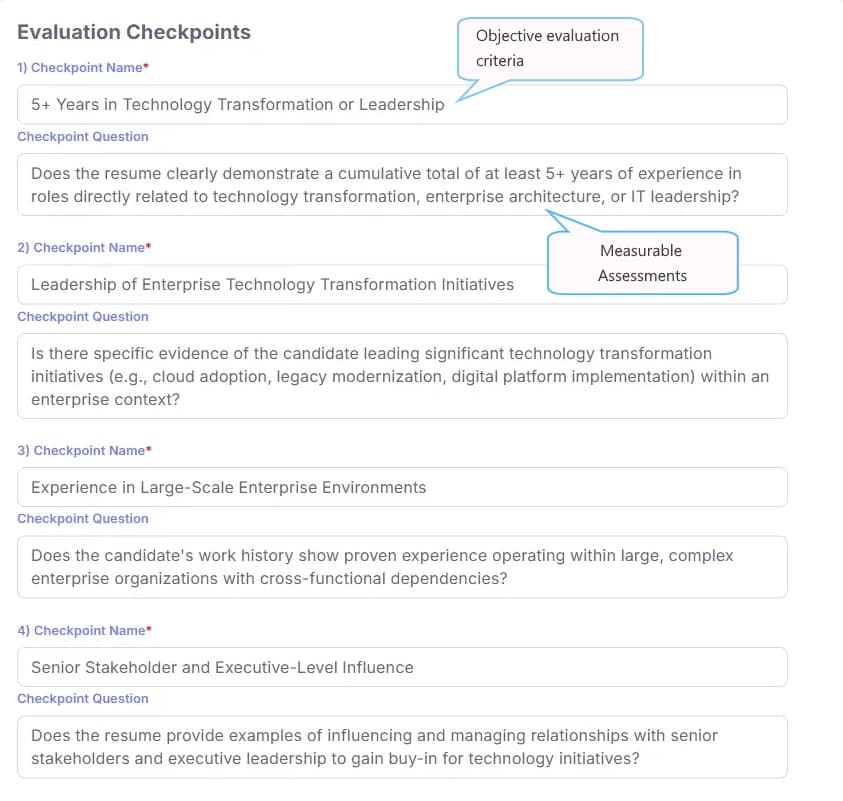
Your team should define scoring logic before candidates enter the funnel.
As shown in the image at the top of this page, when evaluation criteria are set in advance, shortlisting becomes objective, comparable, and easier to defend. Recruiters and hiring managers can assess candidates against one shared score model instead of fragmented interview preferences.
This also improves ranking readiness for structured scoring systems and reduces bias from reactive criteria changes after interviews start. Our recruiters work closely with hiring managers to build this criteria with AI assisted tools.
Once this role-fit baseline is agreed, hiring managers can use ARIC on byteSpark.ai to interrogate shortlisted profiles before interviews and prepare precise validation questions. Continue with Hiring Manager Interview Focus and Validation.
Shortlisting Impact
Better role definition leads to stronger early pipelines and faster decision cycles.
Teams that define role-fit criteria early spend less time reviewing irrelevant profiles and more time evaluating real contenders. This improves speed-to-shortlist without sacrificing decision quality.
In practice, this means fewer restarts, tighter manager-recruiter alignment, and clearer rationale at final decision stage.
Implementation Checklist
Use this before your next role goes live.
- Define what success looks like at 30, 60, and 90 days before writing the job brief.
- Separate must-have outcomes from nice-to-have preferences to reduce false filtering.
- Write evaluation criteria in observable language so interviewers can score consistently.
- Align hiring manager and recruiter on decision thresholds before outreach starts.
- Use one shortlisting scorecard so every candidate is compared on the same evidence model.
Want to apply this model across your active mandates?
Start with the full resource hub or discuss your current hiring requirements with the team.