
Supporting Guide
Structured Shortlist Comparison
Hiring managers need a clear view of candidate strength before interviews begin. When comparison is structured, decisions are faster, more objective, and easier to align across stakeholders.
This guide explains how a unified candidate comparison view helps teams evaluate multiple dimensions at once without losing context.
Why This Matters
Fragmented interview notes make comparison inconsistent and hard to defend.
Hiring decisions often involve multiple interviewers, shifting priorities, and large information volume. When evidence is scattered across notes and memory, final comparison becomes opinion-heavy instead of criteria-led.
Structured shortlist comparison solves this by giving hiring managers one place to review candidates against shared parameters before interview panels begin.
How To Read The View
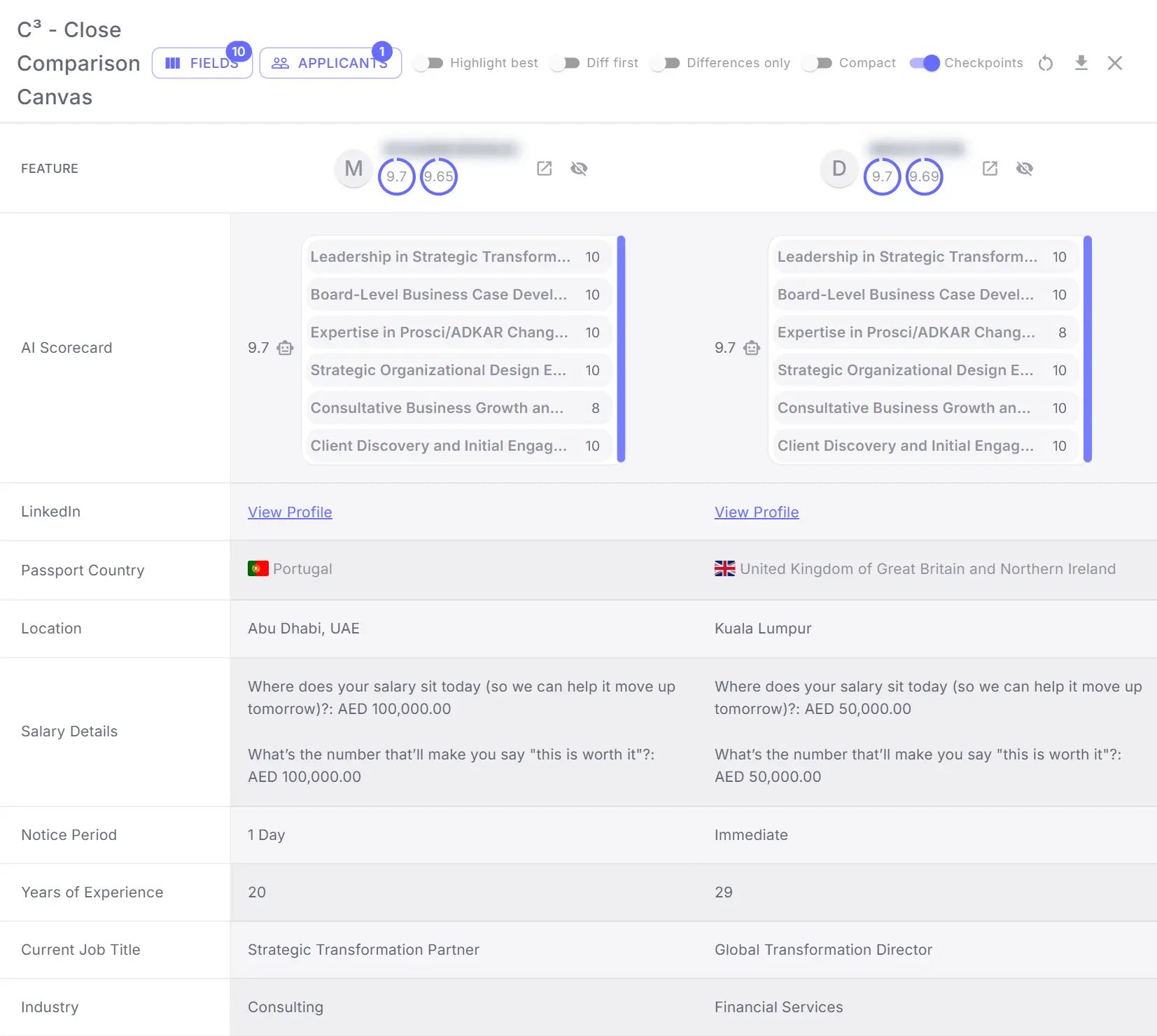
Use one evidence model to compare top candidates side by side.
As shown in the image at the top of this page, each candidate is evaluated against the same role criteria. This gives hiring managers fast visibility into where each person is strongest, where gaps exist, and where deeper interview probing is required.
Instead of scanning disconnected comments, managers can review a normalized view of criteria, scores, and supporting rationale in one decision canvas.
Score Logic and Justification
Individual scores should map to clear criteria and explainable evidence.
Parameter-level visibility only works when criteria are defined clearly up front. If you have not read that setup process yet, start with Role-Fit Clarity.
Each individual score should then be justified in a way that hiring managers can inspect and challenge without ambiguity. The next guide will cover this in depth: Bias-Free Evaluation and Scoring.
Pre-Interview Decision Clarity
Hiring managers can enter interviews with targeted questions, not generic assumptions.
A clear pre-interview view allows teams to identify what must be validated for each finalist. This improves panel discipline and keeps interviews focused on high-impact unknowns rather than repeating basic screening.
The outcome is better signal quality from interviews, stronger final alignment, and fewer late-stage reversals.
Hiring managers can make this workflow even faster with ARIC on byteSpark.ai by turning shortlist insights into instant interview probes. Continue with Hiring Manager Interview Focus and Validation.
Manager Checklist
Use this before moving shortlisted candidates to final stages.
- Confirm every candidate is evaluated against the same predefined criteria.
- Review parameter-level scores before interviews, not only final rankings.
- Validate that every individual score includes clear supporting evidence.
- Identify strongest and weakest dimensions for each finalist before panel discussions.
- Enter interviews with targeted validation questions instead of broad opinion-led prompts.
Continue exploring structured hiring decision frameworks.
Return to the resources hub or continue with role-fit setup guidance.