
Admin roles
30 to 90 days
Wide variance usually comes from approval lag and interview scheduling gaps.
Supporting Guide
Hiring timelines should reflect how each talent segment actually moves in market conditions. When teams use role-specific velocity benchmarks, planning becomes realistic and execution improves.
This guide explains how to read recruitment velocity, identify bottlenecks early, and reduce top-candidate loss caused by avoidable delays in the pipeline.
Why Velocity Matters
Sector movement is not uniform. A timeline that works for one role family can fail in another. When processes extend beyond realistic market windows, candidates may accept another offer, start a new project, or choose to stay in their current role.
Velocity data gives leadership and recruitment teams a shared planning language for urgency, resource allocation, and escalation timing.
Sector Benchmarks
Across our platform data from the last four years, the following ranges reflect how long each sector can typically absorb before candidate momentum starts to weaken.
Admin roles
Wide variance usually comes from approval lag and interview scheduling gaps.
Tech roles
High-demand candidates move quickly, so slow interview loops cause drop-off.
Finance roles
Delay often appears between final assessment and decision confirmation.
C-Suite roles
Longer cycles are expected, but bottlenecks still need active executive alignment.
Development roles
Candidate momentum declines when role scope and timeline are unclear.
Pipeline Visibility
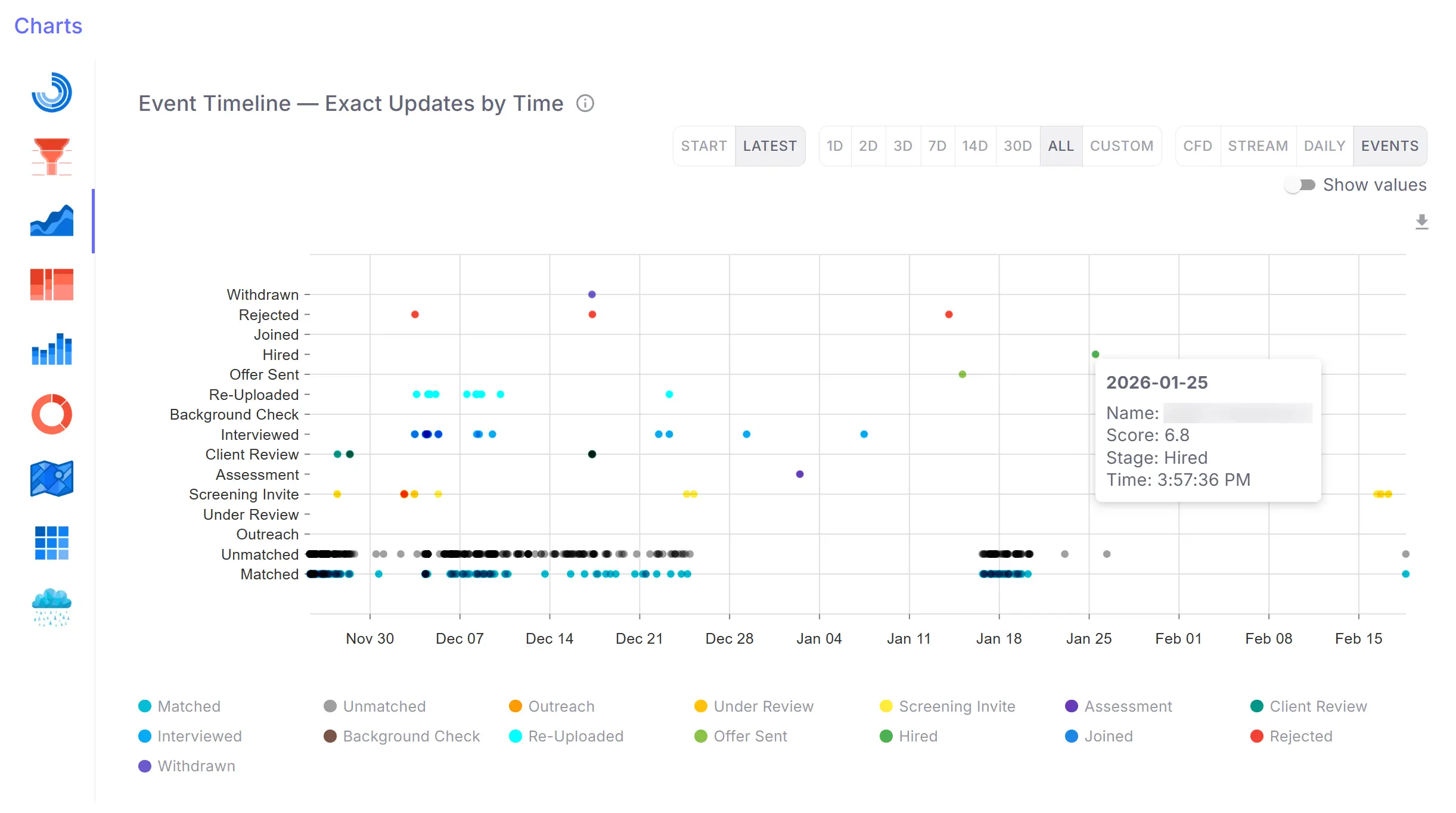
The timeline view below helps teams track how candidates move through the recruitment funnel and where flow begins to slow down. This is especially valuable when volume is high and multiple roles are active in parallel.
Bottleneck Diagnosis
It is not enough to know overall cycle length. Teams need clear timestamps for each handoff:
With this view, recruiters can identify whether delays are driven by screening capacity, hiring-manager response time, or offer-cycle friction, then intervene before losing top talent.
ARIC on byteSpark.ai helps reduce hiring-manager response latency by giving instant profile briefings, interview questions, and validation cues in one place. See Hiring Manager Interview Focus and Validation.
Operating Checklist
Explore related guides to connect timeline velocity, role-fit definition, and shortlist quality.