
Supporting Guide
Bias-Free Evaluation and Scoring
Receiving a large volume of CVs is inevitable. What matters is whether every candidate is evaluated consistently against role-relevant criteria, with evidence that hiring managers can review.
This guide explains how structured AI-assisted evaluation helps teams reduce subjective drift and make clearer shortlisting decisions at scale.
Volume Reality
High CV volume is unavoidable, but inconsistent evaluation is optional.
Hiring teams often face more profiles than any one person can process deeply in limited time. At the same time, hiring managers want multiple capability dimensions checked before interviews.
Without structure, important evidence can be missed and candidate ranking can drift toward whatever is easiest to remember.
Human Limits
Recruiters and managers cannot reliably retain every detail across every CV.
A recruiter may not know role-specific nuances in every specialized domain. Under time pressure, evaluation may overweight vocabulary from the job description rather than actual evidence of fit.
Candidates can describe similar capability in different language. If evaluation depends only on wording familiarity, strong candidates may be overlooked.
AI Support Today
Modern language models help evaluate meaning, not just keyword matches.
Advanced AI systems powered by language models can process context across large candidate sets. Many modern models are trained on very large parameter scales and broad knowledge corpora, which supports deeper semantic interpretation than manual keyword scanning alone.
This reduces the risk that candidate quality suffers due to knowledge gaps in a busy recruiting workflow, especially in highly specialized roles.
Unbiased Checkpoints
Role-defined checkpoints create fairer, clearer first-gate evaluation.
Checkpoints should be defined early in the workflow. If you want to review that setup, start with Role-Fit Clarity.
Once checkpoints are fixed, each CV can be assessed against evidence relevant to those criteria. This keeps screening anchored to performance potential rather than personal or proxy attributes.
- Age
- Gender
- Marital status
- Institution prestige as a proxy for skill
- Employer brand name as a substitute for evidence
Image Explained
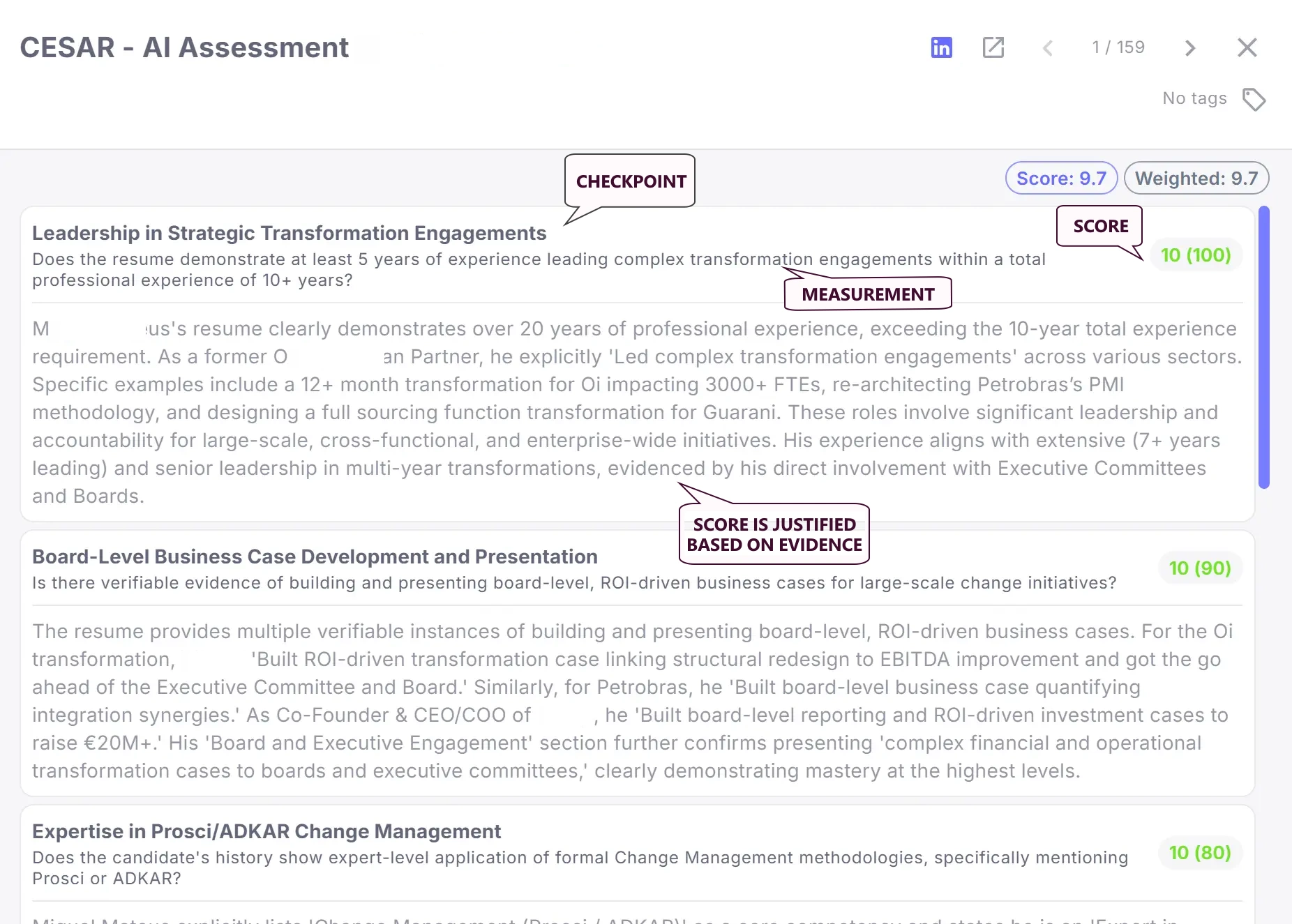
The score is not arbitrary. It is justified with criterion-level CV evidence.
The image on this page shows criteria and measurements agreed with the hiring manager during early role-definition stages. For each checkpoint, the evaluation engine provides score outputs plus a detailed justification grounded in evidence found in the CV.
In this first gate of recruitment, the CV is treated as the source of ground truth. This makes score interpretation transparent and easier for hiring managers to review before interview decisions.
Once this evidence is available, hiring managers can use ARIC on byteSpark.ai to interrogate specific criteria, challenge assumptions, and prepare validation questions without breaking objectivity. See Hiring Manager Interview Focus and Validation.
Operating Checklist
Use this to apply bias-free evaluation at hiring scale.
- Define checkpoints in advance with hiring manager alignment before CV review starts.
- Evaluate each CV against the same criteria and weight logic.
- Capture evidence-based justifications for every score at criterion level.
- Exclude personal attributes that are not relevant to role performance.
- Use shortlist comparison views so decisions are based on structured evidence, not memory.
Continue with structured hiring frameworks.
Explore related resources and compare candidate evidence using a unified decision model.